
The cattle farming industry is undergoing a remarkable transformation as innovative farmers discover the hidden value in what was once considered mere waste. Traditional cattle operations are evolving into integrated systems where cow dung becomes a valuable resource rather than an environmental burden. This shift represents a promising pathway to improved profitability, sustainability, and environmental stewardship in modern agriculture.
The Untapped Potential of Cattle Waste
Cow dung is a significant byproduct of cattle farming that, when improperly managed, can pollute the environment, disturb the scenery, and potentially become a vector for disease transmission. However, this same material is classified as a lignocellulosic biomass resource primarily composed of cellulose, hemicellulose, and lignin—making it an excellent feedstock for various valuable products.
Forward-thinking farmers are now recognizing that proper management and processing of cow dung can transform an environmental liability into an economic opportunity while addressing sustainability challenges. The journey from viewing cow dung as waste to treating it as a resource represents a paradigm shift in agricultural thinking that aligns perfectly with circular economy principles.
Sustainable Cattle Farming: Balancing Production and Environmental Impact

The cattle industry faces mounting pressure to reduce its environmental footprint, particularly regarding methane emissions and waste management.
Jigsaw Farms in south-western Victoria, Australia, pioneered an approach to carbon-neutral beef farming as early as 2011, implementing extensive tree planting alongside soil nurturing practices to sequester carbon and offset methane emissions from their livestock.
Though the farm eventually lost its carbon-neutral status around 2017 as tree carbon sequestration slowed while methane emissions continued, their experience highlights both the possibilities and challenges of sustainable cattle farming.
As Professor Richard Eckard noted, “Cows and sheep are still there, producing the same amount of methane, but the trees grow up and carbon sequestration slows down.
This reality underscores the need for comprehensive approaches to sustainability that address multiple aspects of cattle farming, including innovative waste management systems that can provide ongoing environmental benefits.
Biogas Production: Energy from Waste
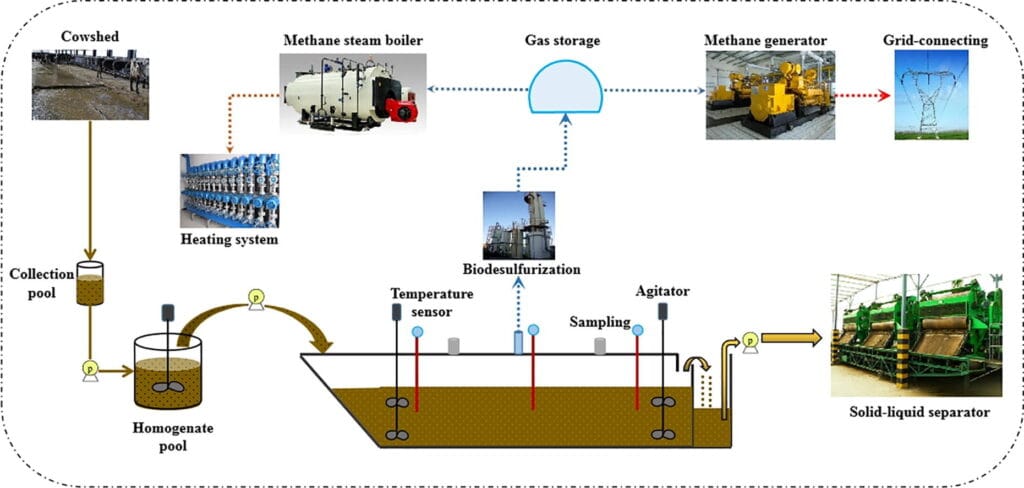
One of the most established methods of processing cow dung is through anaerobic fermentation in biogas reactors. This process involves fermenting cow dung in an oxygen-free environment where microorganisms break down the organic matter to produce biogas rich in methane.
The biogas generated through this process offers numerous practical applications:
- Direct replacement for LPG gas and kerosene in cooking and heating
- Fuel for electricity generation
- Power source for water pumps used in irrigation
- Alternative fuel for modified gasoline engines
Beyond providing renewable energy, biogas production systems help reduce methane emissions that would otherwise be released during the natural decomposition of manure, thereby providing a double climate benefit. The potential of biogas from cow dung addresses several challenges faced by rural communities, including fuel scarcity, high energy costs, and environmental pollution.
High-Value Biochemical Production
Recent research has demonstrated remarkable potential for converting cow dung into valuable industrial chemicals. Scientists have achieved levulinic acid (LA) yields of 338.9 g/kg from pretreated cow dung—significantly higher than the 135 g/kg yield from raw cow dung.
The key to this impressive yield lies in pretreating cow dung with potassium hydroxide (KOH) solution, which breaks down the lignin fraction in the lignocellulose structure, enhancing accessibility during subsequent catalytic reactions. This process also generates formic acid as a valuable byproduct, with yields around 160 g/kg, resulting in combined yields of approximately 500 g/kg for both chemicals.
Levulinic acid is particularly valuable as a platform chemical with applications in pharmaceuticals, plasticizers, and as a precursor for various industrial products. The production process has shown tolerance to high initial substrate loading while maintaining satisfactory yields, making it potentially scalable for commercial applications.
Agronomic Applications: Closing the Nutrient Loop
The residue remaining after biogas extraction—commonly called digestate—contains concentrated nutrients that make excellent organic fertilizer. When properly processed, this material provides a slow-release nutrient source that improves soil health, water retention capacity, and long-term fertility.
By applying this nutrient-rich material back to agricultural fields, farmers complete a perfect circular system: crops feed cattle, cattle produce manure, manure generates energy and fertilizer, and fertilizer grows more crops. This approach minimizes external inputs while maximizing resource utilization.
Implementing Circular Economy Principles in Cattle Operations
The circular economy concept aligns perfectly with zero-waste cattle farming. As Linda Midgley, senior director of sustainability for Cargill’s animal nutrition and health business, explains: “We’re talking about a system that reduces waste by carefully considering every ingredient. We want to leave our world a better place than the way we found it.
Interestingly, livestock farmers have long practiced aspects of circular economy before the term became popular. In the United States, over 40% of feed ingredients are byproducts of other industries, diverting approximately 113.6 million tons of materials from landfills annually. Cattle have the remarkable ability to convert low-value or inedible (to humans) materials into high-quality protein and other valuable products.
This inherent upcycling capability forms the foundation of a zero-waste approach that can be extended to managing the waste produced by the cattle themselves, creating truly circular farming systems with multiple value streams.
Practical Implementation Steps for Farmers Assessment and Planning
The journey toward zero-waste cattle farming begins with a thorough assessment of current operations, herd size, and waste production volumes. This baseline information helps determine the most appropriate processing technologies and potential product streams.
Different scales of operation will suit different approaches:
- Small-scale farms may benefit from simple biodigester systems primarily providing energy for on-farm use
- Medium-sized operations might implement more sophisticated biogas systems with electricity generation capabilities
- Large commercial operations could explore integrated systems combining biogas production with chemical extraction processes
Technology Selection and Infrastructure Development
Based on the assessment, farmers can select appropriate technologies. For biogas production, options range from simple covered lagoon digesters to more complex complete mix or plug flow systems. The choice depends on climate, manure handling systems, and desired end products.
For biochemical production, pretreatment facilities and processing equipment represent significant investments that may be more suitable for cooperatives or larger operations with sufficient scale to justify the capital expenditure.
Market Development and Revenue Streams
The successful implementation of zero-waste approaches requires identifying and developing markets for the products generated. These might include:
- On-farm use of biogas and electricity
- Sale of excess electricity to the grid
- Distribution of processed fertilizer to nearby farms
- Partnership with chemical companies for biochemical byproducts
Educational Needs and Knowledge Transfer
A significant barrier to wider adoption of cow dung processing technologies is the knowledge gap among farmers and rural communities. Research recommends providing education about the utilization of cow dung to obtain optimal results3. This education should cover:
- Basic principles of anaerobic digestion and biogas production
- Safety considerations for biogas handling and use
- Best practices for digestate management and application
- Economic analysis and business planning for waste-to-value systems
Conclusion
The transformation of cattle farming through zero-waste cow dung processing represents a win-win-win scenario: better farm economics, improved environmental outcomes, and enhanced community resilience through local energy production. By viewing cow dung as a valuable resource rather than a waste product, farmers can discover new revenue streams while addressing environmental challenges.
From biogas for cooking and electricity to high-value biochemicals and organic fertilizers, the humble cow pat contains remarkable potential waiting to be unlocked through appropriate processing technologies. As these approaches mature and scale, they have the potential to fundamentally reshape the economics and sustainability of cattle farming worldwide.
The cattle farm of tomorrow will likely be an integrated bio-refinery—producing food, energy, and industrial raw materials while minimizing environmental impact through circular systems that transform every output into valuable inputs for another process. This vision represents not just sustainable agriculture, but regenerative farming that builds natural capital while meeting human needs.